Double Your Money

Posted by on September 30, 2009
Uncategorized / Comments Off on Double Your Money

The top pros in any business have little tips and tricks they use to make their jobs easier. The finance industry is no different. One of their little tricks is called the Rule of 72.

Rule of 72

Do you know how long it takes for your investments to double? There is a quick and easy formula to estimate it. It’s called the Rule of 72. Take your return or interest rate and divide it into 72. The answer will be the approximate number of years it takes to double your money.

Example: If your investments are earning you 8%, divide 8 into 72 and you get 9 years.
If your investments are earning you 10%, divide 10 into 72 and you get 7.2 years.

The formula looks like this:

72 divided by 8 = 9
72 divided by 10 = 7.2

Is the Rule of 72 exact?

No, not exactly, but it is pretty close. The chart below compares the rule of thumb to the real number. You can see it is not perfect but it is pretty good for a ball park estimate. You certainly wouldn’t use it anytime you needed to calculate real returns, However it is perfect for a quick off the top of your head number.
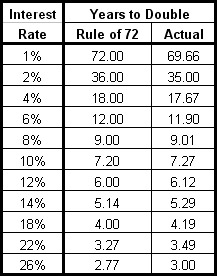
Rule of 72

Using the Rule of 72

So lets say you go into a bank and ask how much their CD rates are. When they tell you 2% a little math in your head and you know it will take about 36 years for our money to double. It might make you rethink those low rates.

Often the results are round numbers, making it an easy calculation you can do in your head. Even for those without a good head for numbers, a few keystrokes on the calculator, and your friends will think you are a genius. When you want to figure how fast your earnings will grow, just remember the Rule of 72.

Learn How to Invest in Apartment Buildings

Posted by on September 12, 2009
Uncategorized / Comments Off on Learn How to Invest in Apartment Buildings

high rise apartment buildingI am currently assisting to teach a year long class on Multi-unit investing.  Several people have asked me if they can join. No, the class is too far along to join at this point.  However because of the demand a second class is forming in Northern Virginia.

Introducing REACH – Real Estate Apprenticeship in Commercial Housing

Would you like to learn how to invest in apartment buildings? Better yet would you actually like to DO IT? REACH is a year long class that is a great opportunity to learn more than just theory, it is a chance to actually do a deal! The members will break up into groups of five, with the goal of each group to actually purchase an apartment building during the course of the class.

You see most real estate instruction is about giving you information and hoping you will then go out and do deals.  Sadly, after the excitement of a class is over, most people don’t take action.  In fact many are not geared to help you learn, but to entice you into ever more expensive classes and coaching programs. This class is different.   It is about helping you get real results.

Why you will succeed with this class.

  • There is a focus on attitude and overcoming fears
  • You will work with a team to motivate you and hold you accountable
  • Workload will be divided up among team members
  • You will focus on your strengths and your areas of interest, while other team members handle areas of their own strengths.
  • Your weak areas are covered by your teammates strengths
  • You will be taught by an experienced team of instructors, who are doing this business in today’s market.
  • What you will learn and do

  • Create an LLC
  • Write a business plan
  • Learn marketing and how to have a constant flow of deals coming to you
  • Learn to evaluate deals
  • Create letters of intent
  • Go to contract and do due diligence
  • Learn how to raise the money
  • Create syndications and learn SEC regulations
  • Learn how to manage the properties and maximize their profit potential.
  • How do I get involved

    The year long class is limited to 25 People and the cost is $2950.00. More importantly that the money, you must be committed to doing the work. If you want to get involved contact me  at the Baltimore Real Estate Investing Blog and I’ll be glad to send out an application.

    Sign up here for a class application

    Happy investing,

    Ned Carey

    General Growth Properties Files for Chapter 11 bankruptcy

    Posted by on April 18, 2009
    Uncategorized / Comments Off on General Growth Properties Files for Chapter 11 bankruptcy

    General Growth Properties Filed for Chapter 11 Bankruptcy this week. Headquartered in Chicago, General Growth is reportedly the second largest mall owner in the country with holdings throughout the country. This would be the largest real estate bankruptcy ever filed.

    The name General Growth is appropriate. They have been buying up retail properties around the country. In 2004 they purchased the  Rouse Company, the original developers of Columbia, Maryland.  They leveraged heavily to make these purchases, reportedly amassing $27 Billion in debt.  As loans came due during this tough credit market, they had trouble finding lenders who would refinance the debt.

    General Growth has been struggling for months to refinance their debt . They put several properties up for sale last fall.  President of General Growth, Thomas Nolan said;  “We want to come out as a less leveraged company. Our business model remains strong.”

    General Growth will continue operating the malls and says it  expects shoppers will notice no changes. They have found debtor in possession financing at 12% above LIBOR.  That’s a tough loan to have to carry, and one has to wonder how long they can hold on if vacancies were to increase.

    General Growth claims to have a 92.5 % occupancy rate but a casual observation of the holdings in the Baltimore area might suggest a lower number than that. Could this be the first sign of a collapse of the commercial retail real estate market. As retailer continue to struggle vacancies could increase. Weak retail sales mean lower percentage rents.  Do I hear a buying opportunity?

    Multi-Family Millions by Dave Lindahl

    Posted by on March 27, 2009
    Uncategorized / Comments Off on Multi-Family Millions by Dave Lindahl

    multifamily-millions-bookDave Lindahl’s recent book  is about repositioning Apartment buildings. This is truly one of the better books on real estate investing that I have read. The obvious focus of this book is apartment buildings,  yet it has value for single family home landlords also.  Owners of other classes of commercial property like office, retail, or industrial will find little of interest.

    Not Just About Repositioning

    For those new to the commercial property business, repositioning would be the equivalent of rehabbing a single family home. Usually some renovation is required but it is more than just renovation It is often also about upgrading the tenants, management and the Position of the property in the marketplace.

    While the thrust of the book is repositioning, he covers the topic from start to finish. He goes into topics like where to find your deals, how to analyze the deals, how to manage the properties and where to get the money. Chapter title s include:

    • An overview of how to get your first deal
    • Separating the gold mine from the land mines
    • Twelve negotiating secrets of the Pros
    • How to avoid being a landlord: Secrets to hiring great property managers
    • Creating your success team
    • Reselling for huge profits

    As you can see there is plenty of interest here for anyone interested doing multi-family deals.

    Who Should Buy this Book

    Investors who want to invest in apartments will find this to be a wonderful book. Yet there is value to single family home landlords, and rehabbers.  This is one of the better books I have read on real estate investing.  In addition to really solid information it is well written, easy to read and easy to understand. Just as importantly it is not full of irrelevant fluff like so many investing books. I recommend this book highly. You can buy it from Amazon at a great price here. Multi-Family Millions: How Anyone Can Reposition Apartments for Big Profits

    Will Your Residential Experience Transfer To Commercial Real Estate Investment?

    Posted by on March 01, 2009
    Uncategorized / Comments Off on Will Your Residential Experience Transfer To Commercial Real Estate Investment?

    If you have some experience investing in residential real estate, how much of your knowledge applies to investing in commercial real estate? Unfortunately, probably not very much. Your knowledge of financing terms and of some general real estate terms will be helpful. But beyond that, it’s like comparing apples to oranges. Without getting too complex, let’s take a look at the major differences.

    The value of residential real estate is usually determined when a buyer and seller agree upon a price based on comparing the recent sales prices of other nearby properties with similar characteristics. For instance, the selling price of a three bedroom two bath house with no upgrades will usually be within 1% to 2% of other similar three bedroom two bath houses in the neighborhood. This is called the sales comparison approach, and it’s the standard method that buyers and sellers use to determine value for single-family properties.

    For commercial real estate, the standard method for determining value is to measure and compare cash flows. Of course, the physical characteristics of a commercial property are valued as assets on the owner’s business balance sheet. But the primary method of deciding on a purchase price for commercial property is to compare its cash flow with the cash flow of other investment opportunities.

    This unit of measurement is called Net Operating Income, or NOI. It’s calculated by subtracting operating expenses from operating income. The rate of return that the investor wants to make on his money will determine the amount that he’s willing to pay for the cash flow.

    For example, if an office building has a net operating income of $50,000 per year, and the investor needs to make a 10% return on his money, he would be willing to pay $500,000 for the property.

    The investor would be comparing the purchase of the office building with other opportunities to make a 10% or higher return. If he could purchase a $60,000 per year cash flow for that same $500,000 he would make a 12% return on his investment.

    In that case, of course, he would buy the apartment building instead of the office building because he’s comparing cash flows. Notice that he’s not concerned that one is an apartment building and one is an office building. His investment goal is to get the highest Return On Investment, or ROI for the $500,000 that he’s spending.

    With residential real estate, the value lies in the physical assets of the building and the land that it sits on. Additional value is created through making improvements to the property and through appreciation, if and when that occurs. With commercial real estate, the value lies in its cash flows, which can be increased either by decreasing expenses or by increasing rents.

    Investing in residential real estate is like being able to drive a car. Investing in commercial real estate is like being able to drive an 18 wheeler. They’re very different vehicles.

    About the Author

    Author and entrepreneur Bernz Jayma P. is the owner of a financial blog dedicated to helping people expand their knowledge on personal finance. You may visit his blog at http://www.Invesmint.com.

    Tags: , , ,

    Great Truck, Great Marketing

    Posted by on February 28, 2009
    Uncategorized / Comments Off on Great Truck, Great Marketing

    Hey if you own property your going to need a plumber some day. You might as well hire one with a sense of humor.

    SEC Refuses TIC No Action Letter

    Posted by on February 08, 2009
    Uncategorized / Comments Off on SEC Refuses TIC No Action Letter

    Is a TIC a Security

    One issue that concerns both syndicators and real estate brokers is whether a Tenant in Common transaction is a security. This issue is important because if it is deemed a security real estate brokers may not sell them. Only licensed securities brokers may sell securities. Additionally these securities would need to be registered or qualify for an exemption to registration.

    The SEC has refused to issue a No Action letter in regard to whether Tenant in Common transactions are considered a Security.

    SEC No Action Refusal

    SEC No Action Refusal

    This was in response to a letter requesting No Action on the part of the SEC.  Here is a link to the No Action Request. Below is an excerpt from the first page.

    On behalf of the Broker-Dealer and the sponsors, we respectfully ask that the division concur in our view that, under the facts described below, neither a Master Lease Transaction nor a Property Management Transaction involve a “security” as defined in Section 2(a)(1) of the Securities Act of 1933, as amended (the “Securities Act”), and therefore, confirm that no enforcement action will be taken by the Securities and Exchange Commission (the “Commission”) under Sections 5 or 15 of the Securities Act if a Master Lease Transaction or a Property Management Transaction is effected without registration, or an available exemption from registration, under the Securities Act.

    While this does not mean that that a Tenant in Common transaction is automatically a security, it is  blow to the industry who want to avoid being classified as such.

    Why Tenant in Common?

    There is an entire industry set up to provide prepackaged, turn key, Tenant In Common (TIC) transactions. These are aimed primarily at sellers who have 1031 exchange money to invest.  TICs allow the seller to get a fractional interest in a larger and or better property than they could otherwise obtain.

    They also simplify the process of doing a 1031 exchange and are sometimes used as a backup when the 1st choice of identified properties does not work out.

    Tags: , , , ,

    Welcome to Commercial Real Estate Investing

    Posted by on February 02, 2009
    Uncategorized / Comments Off on Welcome to Commercial Real Estate Investing

    Thank you for stopping by. We created this site to be a source of news, articles, investing tips, and opinion specifically about commercial real estate.  Keep stopping back as we will be adding content regularly. If you are interested in writing articles for the site leave a comment and we will get back to you.